On 11 May 2026, the INPROCAP project hosted its seventh webinar, “Innovation Partnership – Procedure & BSO Practice”, bringing together procurement professionals, Big Science organisations, Industrial Liaison Officers (ILOs), companies and innovation stakeholders to explore one of the most advanced innovation procurement procedures available under the European procurement framework.
The session focused on how Innovation Partnership procedures can support the development and deployment of innovative solutions when no suitable product or service yet exists on the market. Through legal insights, practical examples and real-life case studies from both public authorities and Big Science organisations, participants gained a deeper understanding of how to design and implement Innovation Partnership procedures in practice.
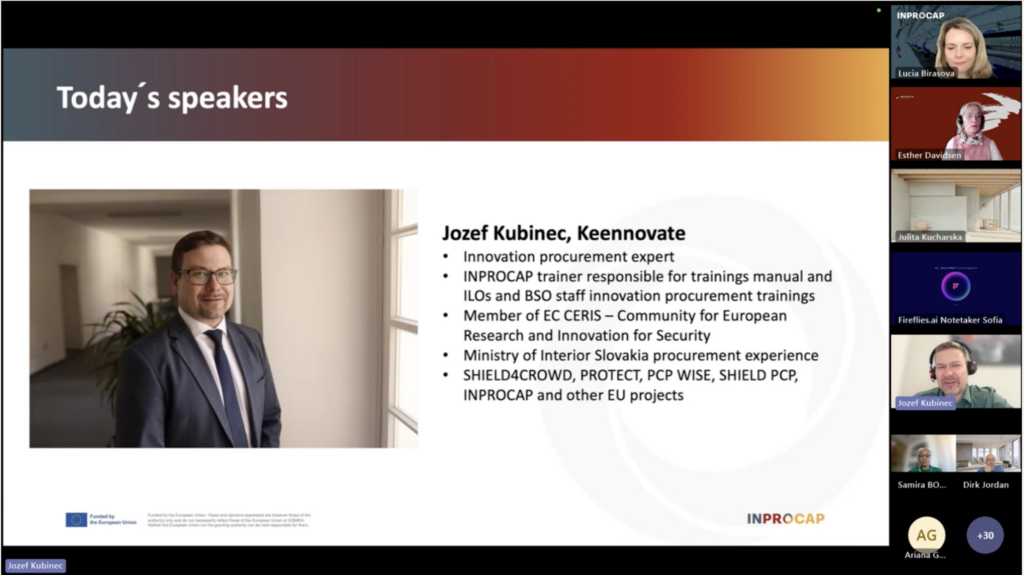
The webinar was opened and moderated by Jozef Kubinec, innovation procurement expert and representative of the INPROCAP project. The agenda featured three expert presentations covering the legal framework, practical implementation and real-life experiences with Innovation Partnership procedures.


Understanding the Innovation Partnership Procedure
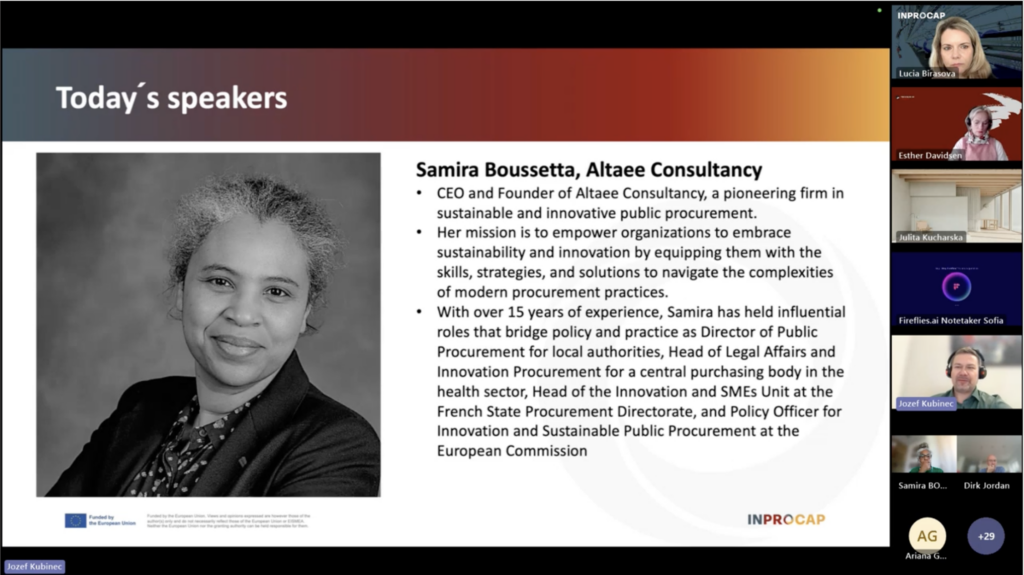
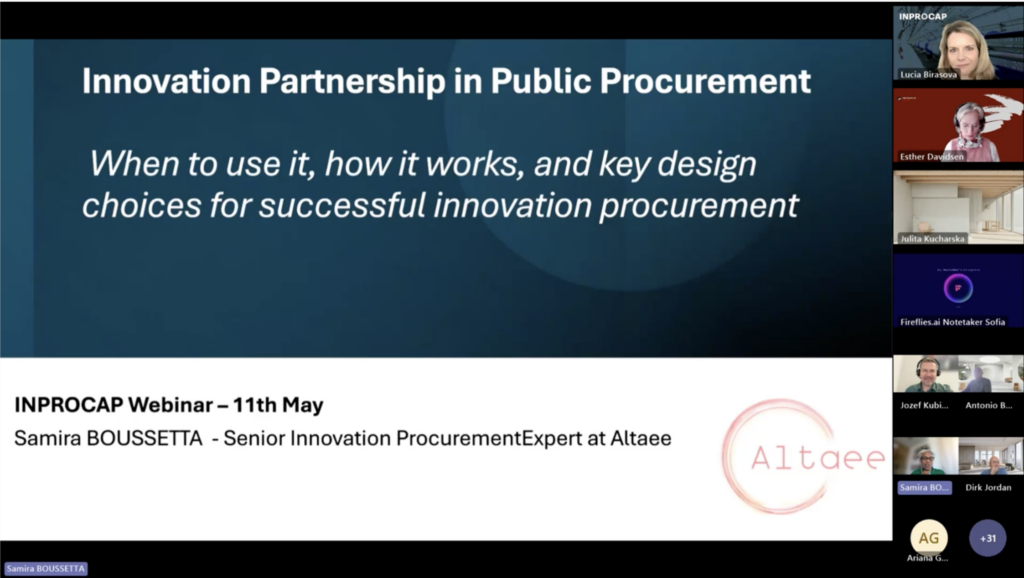
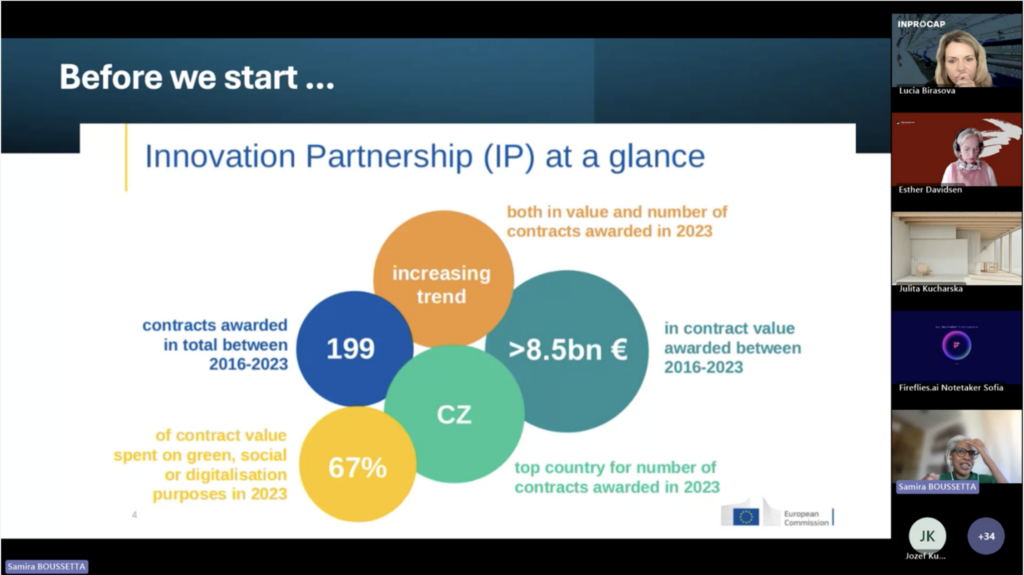
The first presentation, delivered by Samira Boussetta, Senior Innovation Procurement Expert at Altaee, introduced the legal and practical foundations of the Innovation Partnership procedure under Article 31 of Directive 2014/24/EU.
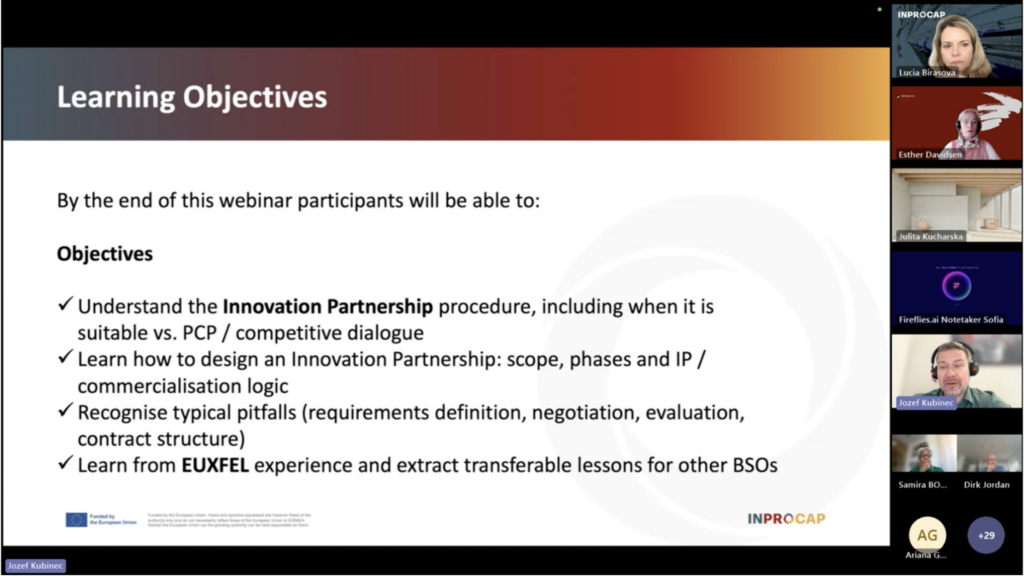
The session explored when Innovation Partnership should be used, how it compares with procedures such as Pre-Commercial Procurement (PCP), Competitive Dialogue and Competitive Procedure with Negotiation, and which key conditions must be fulfilled before launching such a procedure.
Participants learned that Innovation Partnership is particularly suitable when:
- no off-the-shelf solution exists,
- research and development activities are required before deployment,
- contracting authorities intend to combine development and future purchase within one procurement procedure,
- and long-term collaboration with suppliers is needed.
The presentation also highlighted the importance of:
- functional rather than overly prescriptive requirements,
- milestone-based development phases,
- clear award criteria,
- and carefully managed negotiation processes.
A comparison between Innovation Partnership, PCP and Competitive Dialogue helped participants better understand which procurement tool is most appropriate depending on market maturity, technology readiness and procurement objectives.
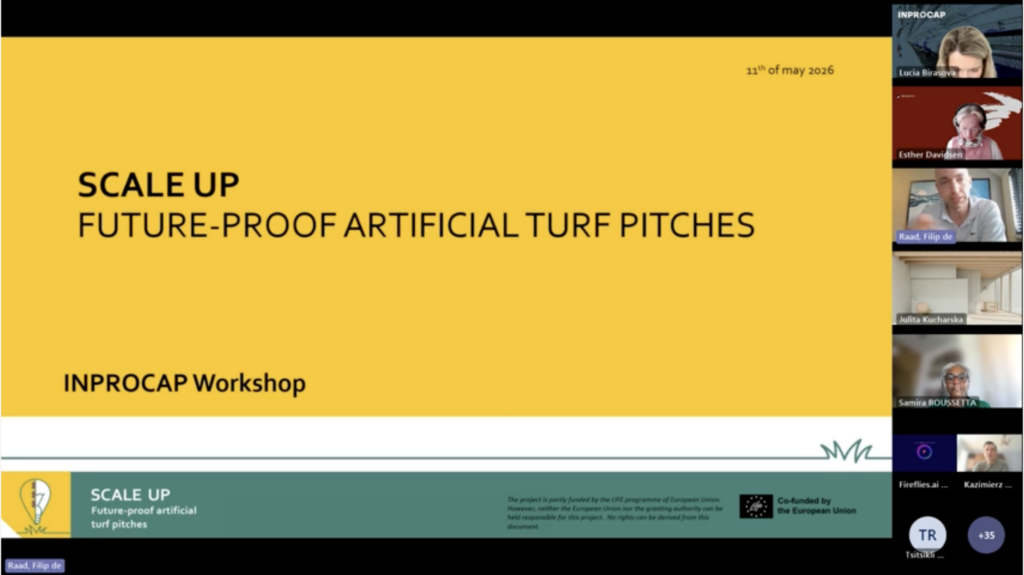
City of Amsterdam: Future-Proof Artificial Turf Pitches
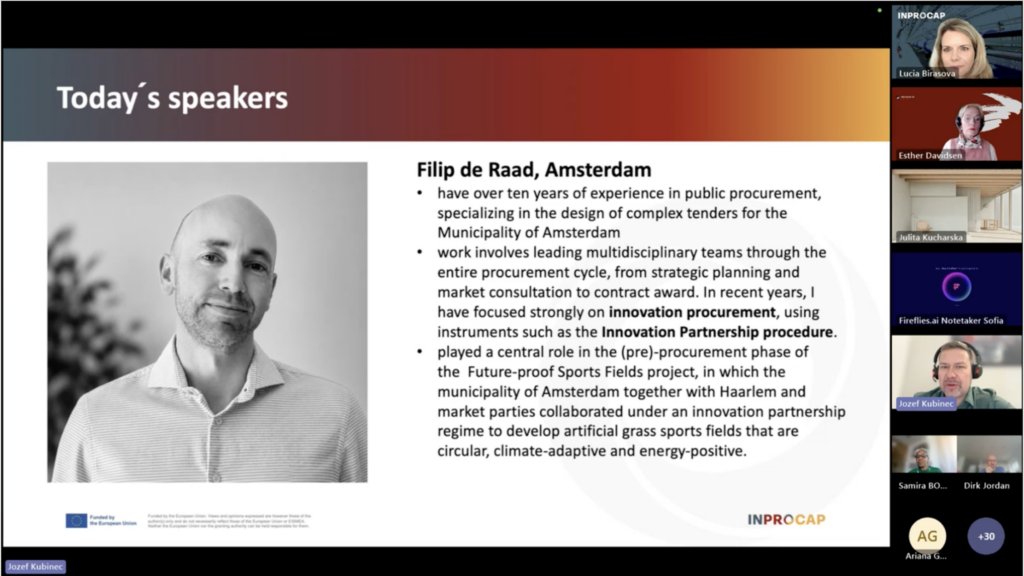
The second presentation was delivered by Filip de Raad, Procurement Advisor from the Municipality of Amsterdam, who shared the innovative SCALE UP project focused on future-proof artificial turf pitches.
The case demonstrated how Innovation Partnership can be applied to address complex sustainability and climate-related challenges in urban infrastructure. Facing increasing demand for artificial turf fields and environmental concerns linked to existing solutions, Amsterdam and its partners launched an Innovation Partnership procedure to co-develop more sustainable and scalable solutions.
The presentation showcased:
- early market engagement activities,
- matchmaking events and consultations,
- collaborative development with multiple partners,
- and the use of long-term procurement strategies to create market pull for innovation.
Participants were also introduced to the project’s large-scale ambition, involving up to 270 fields and long-term cooperation over 10–12 years, with a total contract value exceeding €170 million.
The Amsterdam example highlighted several key lessons learned:
- the importance of management support and organisational commitment,
- involving the market early,
- creating flexible procurement structures,
- and using legal expertise proactively to enable innovation rather than restrict it.
Innovation Partnership in Big Science: The European XFEL Perspective
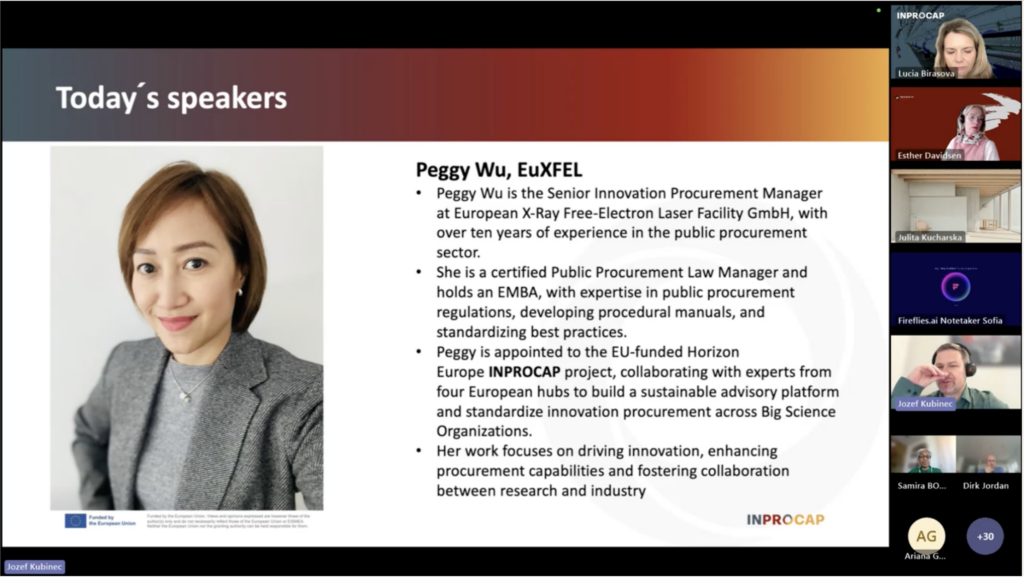
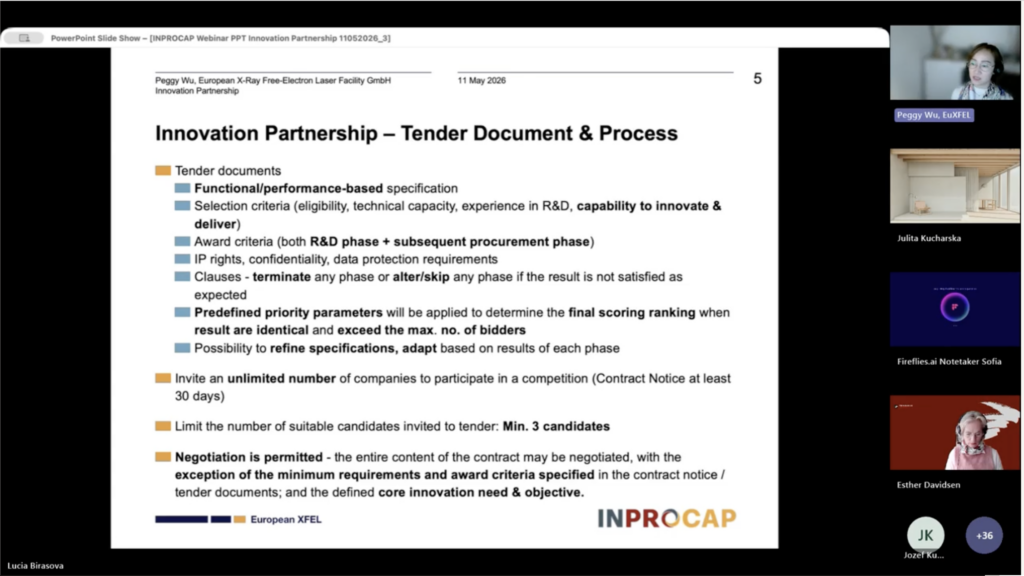
The final presentation was delivered by Peggy Wu, Senior Innovation Procurement Manager at European XFEL, who presented Innovation Partnership examples from the Big Science sector together with the newly developed INPROCAP Innovation Partnership Manual.
The session focused on how Innovation Partnership procedures can support highly specialised research infrastructures where commercial solutions often do not yet exist. Examples from European XFEL demonstrated situations involving:
- high research-and-development-to-product cost ratios,
- unprecedented technical specifications,
- and the need for close co-development between suppliers and research organisations.
Peggy Wu explained how Innovation Partnership enables:
- risk-sharing between contracting authorities and suppliers,
- iterative refinement of specifications,
- feasibility testing during development,
- and the creation of innovative supplier ecosystems for future technologies.
Participants also received an overview of the INPROCAP Innovation Partnership Manual, including:
- process flowcharts,
- role-based guidance,
- preparation checklists,
- and frequently asked questions supporting procurement professionals through the entire procedure lifecycle.
Strengthening Innovation Procurement Capacity Across Big Science
Webinar 7 once again demonstrated the growing importance of innovation procurement procedures in addressing complex technological and societal challenges across Europe. Through practical examples, legal guidance and real-life implementation experiences, participants gained valuable insights into how Innovation Partnership procedures can help bridge the gap between research, development and deployment.
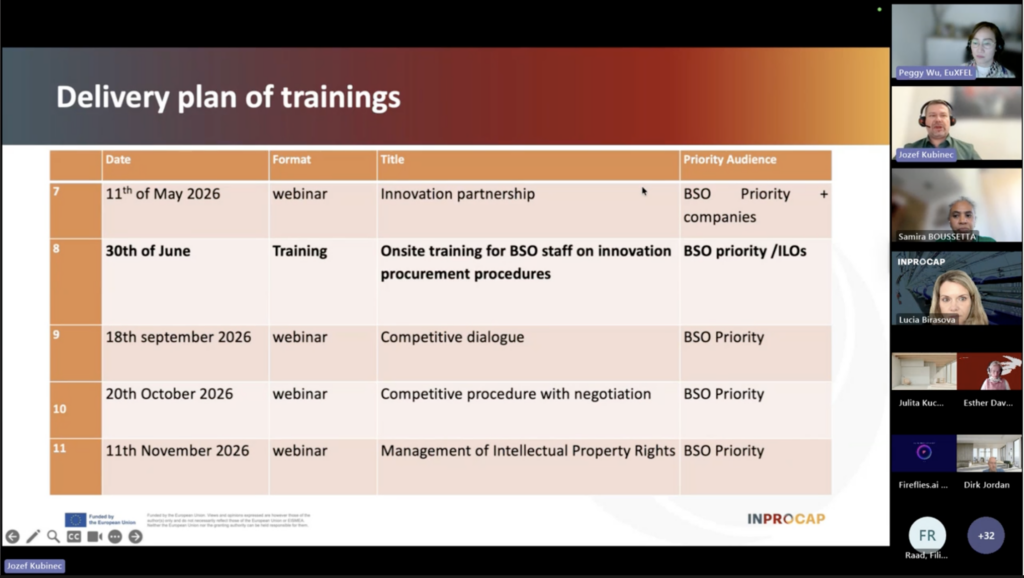
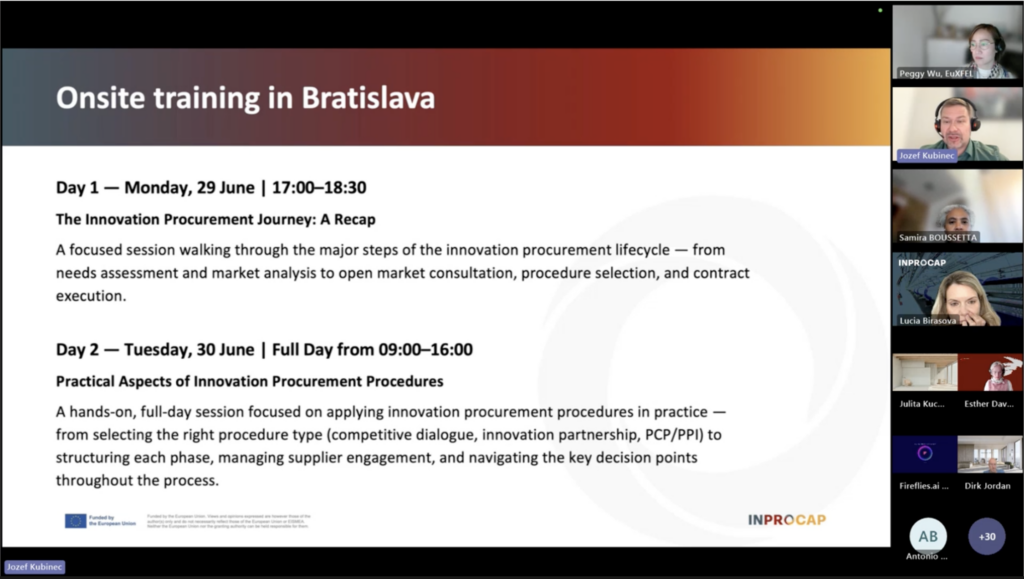
The webinar formed part of the broader INPROCAP Training Journey aimed at strengthening innovation procurement capacities across the Big Science ecosystem and supporting collaboration between research infrastructures, public buyers, companies and innovation intermediaries.