Maastricht, Netherlands | 27–29 October 2026
Innovation procurement is not only about selecting the right procedure. It is about connecting scientific needs with industrial capabilities, creating opportunities for innovative solutions and ensuring that new technologies can be developed and successfully implemented.
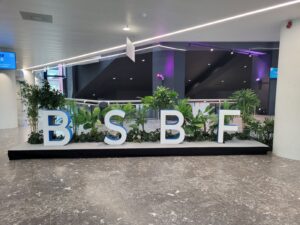
This was a central message of INPROCAP’s participation in the Big Science Business Forum 2026 (BSBF2026) in Maastricht, where the project brought together its international partners, engaged with the Big Science community and presented new practical resources designed to make innovation procurement more accessible.
The project’s participation began with the INPROCAP Satellite Event on 27 October, followed by two days of networking, discussions and knowledge exchange at the exhibition on 28–29 October.
From Innovation Procurement Concepts to Practical Implementation
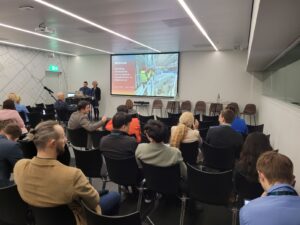
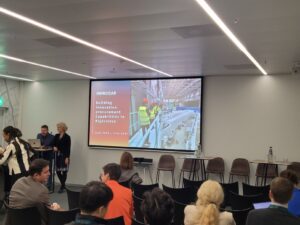
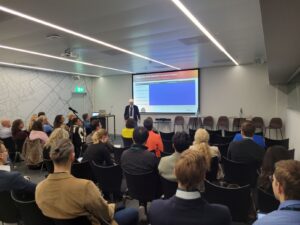
Held on 27 October, the INPROCAP Satellite Event, “Building Skills and Tools for Innovation Procurement in Big Science”, marked an important milestone in translating the project’s knowledge and experience into practical support for Big Science Organisations, Industrial Liaison Officers (ILOs) and innovative companies.
The event opened with Esther Davidsen, INPROCAP Project Coordinator from the Danish Technological Institute (DTI), who introduced the project’s objectives and the importance of strengthening innovation procurement capabilities across Europe’s Big Science ecosystem.
Her presentation highlighted an important challenge: researchers, engineers, procurement professionals and companies often approach innovation from different perspectives. Differences in terminology, organisational priorities and development timelines can make it difficult to transform scientific challenges into concrete opportunities for industrial collaboration.
Addressing these gaps requires more than procurement knowledge alone. It also calls for stronger connections between research infrastructures and innovative companies, opportunities to discuss technological challenges early and dedicated expertise to guide organisations through the procurement process.
Understanding the Needs Behind Procurement Decisions
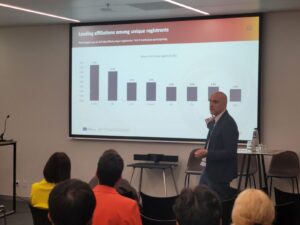
In his presentation, “From Needs to Solutions”, Antonio Bonucci from European XFEL examined how innovation procurement decisions must respond to different stakeholder interests and organisational objectives.
Drawing on INPROCAP’s training activities, he presented the reach of the programme across its first ten sessions, which recorded 214 unique registration identities and 466 individual session registrations. These figures reflect interest from a diverse group of stakeholders, including Big Science Organisations, Industrial Liaison Officers, companies, research organisations and public authorities.
Beyond participation figures, the presentation highlighted that successful innovation procurement requires balancing several objectives: scientific performance, industrial competitiveness, technological sovereignty, regulatory compliance and wider societal value.
Different procurement approaches offer different opportunities and involve different risks. For example, Pre-Commercial Procurement enables competing research and development solutions to be explored, while Innovation Partnerships connect development with potential acquisition. Competitive Dialogue can help clarify complex technological solutions, whereas the Competitive Procedure with Negotiation allows organisations to refine offers when their fundamental requirements are already established.
The key message was that there is no single procurement approach suitable for every innovation challenge. The selection should be driven by the maturity of available technologies, the clarity of procurement needs, the need for further development and the organisation’s long-term objectives.
Practical Tools to Support Innovation Procurement
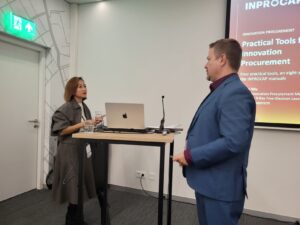
Peggy Wu, Senior Innovation Procurement Manager at European XFEL, continued the discussion with her presentation, “Practical Tools for Innovation Procurement”, focusing on how procurement teams can turn these principles into practical decisions.
She introduced four complementary approaches:
- Functional and performance-based specifications: Defining the expected outcome rather than prescribing a particular technology, leaving room for suppliers to propose innovative solutions.
- Preliminary market engagement: Using market consultations, requests for information and Industry Days to understand technological possibilities before launching a procurement procedure.
- Multi-criteria evaluation: Looking beyond the lowest purchase price to consider technical quality, innovation, lifecycle costs, implementation risks and environmental performance.
- Selecting the right procurement procedure: Choosing an approach based on whether a suitable solution already exists, how clearly the need can be specified and whether further research and development is required.
The presentation also outlined an eight-step procurement journey, from identifying an unmet need and analysing the market to selecting the procedure, preparing procurement documentation, evaluating tenders and monitoring delivery.
Building on this framework, INPROCAP introduced its practical instruction manuals, developed to help professionals understand procurement procedures, identify decision points and navigate their implementation more confidently.
The central takeaway was clear: innovation procurement works best when scientific and operational needs are translated into measurable outcomes, market knowledge informs procurement design and implementation risks are considered from the outset.
Making Innovation Procurement Knowledge Accessible Beyond the Project
A major highlight of the Satellite Event was the introduction of the INPROCAP Online Learning Space & Toolbox, presented by Jozef Kubinec from PEDAL Consulting.
Through a live demonstration, participants were introduced to a freely accessible learning environment designed to help professionals strengthen their innovation procurement knowledge at their own pace.
The platform brings together expert insights, training materials, practical examples and learning activities, building on the knowledge developed throughout the INPROCAP Training Series.
Importantly, the online training resources are also intended to be available for integration into organisations’ existing learning environments, allowing Big Science Organisations and other stakeholders to make use of INPROCAP knowledge within their own internal training activities.
This represents an important step towards ensuring that the project’s results remain accessible and useful beyond individual webinars and training events.
Rather than relying exclusively on one-off training sessions, organisations can use these resources to support continuous learning, strengthen internal expertise and share practical knowledge with colleagues involved in innovation procurement.
Connecting with the Big Science Community at BSBF2026
Following the Satellite Event, the INPROCAP team continued its participation at BSBF2026 on 28–29 October, engaging directly with representatives from Big Science Organisations, Industrial Liaison Offices, research institutions, companies and the wider innovation ecosystem.
The exhibition provided a valuable opportunity to introduce INPROCAP’s newly developed tools, exchange experiences on procurement challenges and discuss possibilities for future cooperation.
These interactions reinforced the importance of bringing together different perspectives. For Big Science Organisations, innovation procurement offers a way to address demanding scientific and technological needs. For companies, particularly SMEs and innovative technology providers, it can create opportunities to develop new capabilities, demonstrate solutions and establish relationships with major European research infrastructures.
Industrial Liaison Officers have an important role in connecting these two communities, helping companies understand Big Science needs while supporting research organisations in identifying relevant industrial capabilities.
By facilitating these exchanges, INPROCAP contributes to building stronger connections between scientific demand and industrial innovation.
From Shared Knowledge to Stronger Innovation Procurement Capabilities
The discussions and presentations in Maastricht highlighted several lessons for organisations seeking to make greater use of innovation procurement.
Early engagement between research infrastructures and industry can help identify feasible technological options and refine procurement needs. Clear functional requirements can encourage suppliers to propose alternative solutions, while appropriate procurement procedures can provide the flexibility needed to develop or adapt technologies.
At the same time, effective innovation procurement must account for long-term considerations such as intellectual property rights, supplier dependency, interoperability, lifecycle costs and the practical implementation of new solutions.
Perhaps most importantly, innovation procurement requires cooperation between technical experts, procurement specialists, legal teams, management and industry. Strengthening these connections is essential for turning innovative concepts into workable solutions.
INPROCAP’s participation at BSBF2026 demonstrated how practical tools, targeted training and collaboration can help bridge the gap between innovation procurement knowledge and its implementation.
With the launch of its learning resources and continued engagement with the Big Science community, the project is supporting a more informed, connected and capable innovation procurement ecosystem.
Explore the INPROCAP training resources and learn more about the project: